What Civilization Believed Family Members Watched Over You
| Filial piety | |||||||||||||||||||||||||||
|---|---|---|---|---|---|---|---|---|---|---|---|---|---|---|---|---|---|---|---|---|---|---|---|---|---|---|---|
 Scene from the Vocal Dynasty Illustrations of the Classic of Filial Piety (detail), depicting a son kneeling before his parents.[i] | |||||||||||||||||||||||||||
| Chinese proper name | |||||||||||||||||||||||||||
| Chinese | 孝 | ||||||||||||||||||||||||||
| |||||||||||||||||||||||||||
| Vietnamese proper name | |||||||||||||||||||||||||||
| Vietnamese alphabet | hiếu | ||||||||||||||||||||||||||
| Korean proper name | |||||||||||||||||||||||||||
| Hangul | 효 | ||||||||||||||||||||||||||
| Hanja | 孝 | ||||||||||||||||||||||||||
| |||||||||||||||||||||||||||
| Japanese name | |||||||||||||||||||||||||||
| Kanji | 孝 | ||||||||||||||||||||||||||
| Kana | こう | ||||||||||||||||||||||||||
| |||||||||||||||||||||||||||
In Confucian, Chinese Buddhist and Taoist[2] ideals, filial piety (Chinese: 孝, xiào) is a virtue of respect for ane'southward parents, elders, and ancestors. The Confucian Archetype of Filial Piety, idea to be written around the late Warring States-Qin-Han period, has historically been the authoritative source on the Confucian tenet of filial piety. The book, a purported dialogue between Confucius and his student Zengzi, is about how to set up a good society using the principle of filial piety. Filial piety is central to Confucian role ideals.
In more general terms, filial piety ways to exist expert to 1'south parents; to take care of ane'southward parents; to engage in skillful carry, not just towards parents just also outside the abode so as to bring a good proper noun to i's parents and ancestors; to show love, respect, and support; to display courtesy; to ensure male heirs; to uphold fraternity among brothers; to wisely advise i's parents, including dissuading them from moral unrighteousness; to display sorrow for their sickness and death; and to bury them and deport out sacrifices afterwards their expiry.
Filial piety is considered a primal virtue in Chinese and other East Asian cultures, and it is the main subject of many stories. I of the most famous collections of such stories is The Xx-four Cases of Filial Piety (Chinese: 二十四孝; pinyin: Èrshí-sì xiào ). These stories draw how children exercised their filial piety community in the by. While Communist china has e'er had a diversity of religious beliefs, filial piety custom has been common to almost all of them; historian Hugh D.R. Baker calls respect for the family the one element common to almost all Chinese people.
Terminology [edit]
The western term filial piety was originally derived from studies of Western societies, based on Mediterranean cultures. However, filial piety amongst the aboriginal Romans, for example, was largely dissimilar from the Chinese in its logic and enactment.[3] Filial piety is illustrated by the Chinese grapheme xiao (孝). The character is a combination of the character lao (old) above the character zi (son), that is, an elder beingness carried past a son.[4] This indicates that the older generation should be supported past the younger generation.[5] In Korean Confucianism, the character 孝 is pronounced hyo (효). In Vietnamese, the character 孝 is written in the Vietnamese alphabet as hiếu. In Japanese, the term is generally rendered in spoken and written language as 親孝行, oyakōkō, adding the characters for parent and conduct to the Chinese graphic symbol to make the give-and-take more than specific.
In traditional texts [edit]
![Illustrations of the Ladies' Classic of Filial Piety (detail), Song Dynasty, depicting the section "Serving One's Parents-in-Law".[6]](https://upload.wikimedia.org/wikipedia/commons/a/a3/Illustrations_of_the_Ladies%27_Classic_of_Filial_Piety.jpg)
Illustrations of the Ladies' Classic of Filial Piety (detail), Song Dynasty, depicting the section "Serving One's Parents-in-Constabulary".[half-dozen]
Definitions [edit]
Confucian teachings nigh filial piety tin be found in numerous texts, including the 4 Books, that is the Great Learning (Chinese: 大学), the Doctrine of the Mean (Chinese: 中庸), Analects (Chinese: 论语) and the book Mencius, as well as the works Classic of Filial Piety (Chinese: 孝经) and the Book of Rites (Chinese: 礼记) .[7] In the Archetype of Filial Piety, Confucius (551–479 BCE) says that "filial piety is the root of virtue and the basis of philosophy"[8] and modern philosopher Fung Yu-lan describes filial piety as "the ideological basis for traditional [Chinese] gild".[9]
For Confucius, filial piety is not merely a ritual exterior respect to one'south parents, but an inward attitude as well.[10] Filial piety consists of several aspects. Filial piety is an sensation of repaying the burden borne by one's parents.[11] Equally such, filial piety is done to reciprocate the intendance one's parents have given.[12] All the same, it is also practiced because of an obligation towards ane's ancestors.[13] [14]
According to some modern scholars, xiào is the root of rén (仁; benevolence, humaneness),[15] but other scholars state that rén, too as yì (義; righteousness) and li (禮; propriety) should be interpreted as the roots of xiào. Rén means favorable behavior to those who we are close to.[16] Yì refers to respect to those considered worthy of respect, such as parents and superiors. Li is defined as behaving according to social norms and cultural values.[xvi] Moreover, it is divers in the texts as deference, which is respectful submission, and reverence, significant deep respect and awe.[10] Filial piety was taught past Confucius as part of a wide platonic of self-cultivation (Chinese: 君子; pinyin: jūnzǐ ) toward being a perfect human.[17]
Modern philosopher Hu Shih argued that filial piety gained its central role in Confucian ideology just amidst later Confucianists. He proposed that Confucius originally taught the quality of rén in general, and did not withal emphasize xiào that much. Just subsequently Confucianists such as Tseng Tzu focused on xiào as the single most important Confucianist quality.[9]
Detailed descriptions [edit]
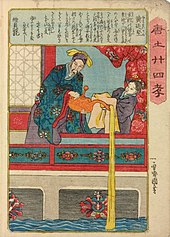
Confucian ethics does non regard filial piety as a option, but rather as an unconditional obligation of the kid.[xviii] The relationship betwixt parents and children is the virtually central of the five cardinal relationships (Chinese: 五倫; pinyin: wǔlún ) described by Confucius in his role ideals,[19] and filial piety, together with fraternal love, underlies this system.[20] Information technology is the central principle of Confucian morality:[21] filial piety was seen as the basis for an orderly guild, together with loyalty of the ministers toward the ruler, and servitude of the married woman toward the husband.[22] In short, filial piety is fundamental to Confucian part ethics[23] and is the cardinal virtue that defines, limits, or even eliminates all other virtues.[24]
Co-ordinate to the traditional texts, filial piety consists of physical care, love, service, respect, and obedience.[25] Children should endeavor not to bring disgrace upon their parents.[26] Confucian texts such as Book of Rites give details on how filial piety should exist adept.[5] Respect is envisioned past detailed manners such equally the way children salute their parents, speak to them (words and tone used) or enter and leave the room in which their parents are, as well as seating arrangements and gifts.[27] Care means making sure parents are comfortable in every single way: this involves food, accommodation, wearing apparel, hygiene, and basically to have them "run into and hear pleasurable things" (in Confucius' words)[28] and to have them live without worry.[12] But the most important expressions of, and exercises in, filial piety were the burying and mourning rituals to exist held in honor of i'south parents.[29] [xv]
Filial piety means to exist good to one'due south parents; to accept care of one's parents; to appoint in expert conduct not just towards parents but also outside the abode so as to bring a skilful name to ane'southward parents and ancestors;[30] to perform the duties of 1's job well (preferably the same job equally 1's parents to fulfill their aspirations)[12] besides as to carry out sacrifices to the ancestors;[31] to not be rebellious;[14] to be polite and well-mannered; to show love, respect, and support; to exist almost home to serve one's parents;[32] to display courtesy;[28] to ensure male heirs[12] and uphold fraternity among brothers;[ citation needed ] to wisely advise ane'due south parents, including dissuading them from moral unrighteousness;[32] to display sorrow for their sickness and death;[33] and to bury them and carry out sacrifices after their death.[34] Furthermore, a filial child should promote the public name of its family, and information technology should cherish the affection of its parents.[12]
Traditional texts essentially describe filial piety in terms of a son–father relationship, but in practice, information technology involves all parent–child relationships, as well as relationships with stepparents, grandparents and ancestors.[35]
But filial piety too involves the role of the parent to the child. The father has a duty to provide for the son, to teach him in traditions of ancestor worship, to observe a spouse for him, and to exit a expert heritage.[36] [35] A father is supposed to exist 'stern and dignified' to his children, whereas a mother is supposed to be 'gentle and compassionate'. The parents' virtues are to be practiced, regardless of the child's piety, and vice versa.[35] Nevertheless, filial piety mostly identified the child's duty, and in this, it differed from the Roman concept of patria potestas, which defined more often than not the begetter's authoritative power. Whereas in Roman civilisation, and later in the Judeo-Christian West, people in authority legitimized their influence by referring to a higher transcending ability, in Chinese culture, authorisation was divers past the roles of the subordinates (son, field of study, wife) to their superior (male parent, emperor, husband) and vice versa. Every bit roles and duties were depersonalized, supremacy became a matter of office and position, rather than person, every bit it was in the West.[37]
Anthropologist Francis Hsu argued that a child's obedience from a Confucian perspective was regarded equally unconditional, but anthropologist David K. Jordan and psychologist David Yau-fai Ho disagree.[35] [14] Jordan states that in classical Chinese thought, 'remonstrance' was part of filial piety, meaning that a pious child needs to dissuade a parent from performing immoral actions.[35] Ho points out in this regard that the Confucian classics do not abet 'foolish filial piety' (愚孝 pinyin: yúxiào ).[fourteen] Nevertheless, Hashemite kingdom of jordan does add that if the parent does not mind to the kid'due south dissuasion, the child must nevertheless obey the parent,[38] and Ho states that "rebellion or outright defiance" is never approved in Confucian ethics.[14]
Filial piety not just extends to beliefs of children toward their parents, merely also involves gratitude toward the human body they received from their parents,[21] [39] as the trunk is seen equally an extension of one's parents.[32] This involves prohibitions on damaging or hurting the body, and this doctrine has affected how the Confucianists regarded the shaving of the caput past Buddhist monks,[21] just likewise has created a taboo on suicide, regarded as 'unfilial behavior' (不孝 pinyin: bùxiào ).[xl]
Relation with guild at big [edit]

A memorial stone at a Korean elementary school, with the inscription "filial piety".
Filial piety is regarded as a principle that ordered lodge, without which chaos would prevail.[22] It is described as "an inevitable fact of nature", every bit opposed to mere convention,[41] and information technology is seen to follow naturally out of the male parent–son relationship.[42] In the Chinese tradition of patriarchy, roles are upheld to maintain the harmony of the whole.[43] According to the Neo-Confucian philosopher Cheng Hao (1032–1085 CE), relationships and their corresponding roles "vest to the eternal principle of the cosmos from which there is no escape between heaven and world".[44]
The idea of filial piety became popular in Cathay because of the many functions it had and many roles information technology undertook, equally the traditional Confucian scholars such as Mencius (4th century BCE) regarded the family unit every bit a fundamental unit that formed the root of the nation. Though the virtue of xiào was about respect past children toward their parents, it was meant to regulate how the immature generation behaved toward elders in the extended family and in society in full general.[45] [46] Furthermore, devotion to one's parents was often associated with 1's devotion to the country,[annotation 1] described equally the "parallel conception of lodge"[47] or the "Model of Ii".[20] The Classic of Filial Piety states that an obedient and filial son will grow up to become a loyal official (pinyin: chung )—filial piety was therefore seen every bit a truth that shaped the citizens of the state,[22] and the loyalty of the minister to his emperor was regarded equally the extension of filial piety.[48] Filial piety was regarded as existence a dutiful person in general.[44]
Nevertheless, the two were not equated. Mencius teaches that ministers should overthrow an immoral tyrant, should he impairment the state—the loyalty to the king was considered conditional, non as unconditional equally in filial piety towards 1 parents.[18]
In E Asian languages and cultures [edit]
Confucian teachings about filial piety have left their mark on East Asian languages and culture. In Chinese, at that place is a saying that "among hundreds of behaviors, filial piety is the most important one" (Chinese: 百善孝为先; pinyin: bǎi shàn xiào wéi xiān ).[46] [8]
In mod Chinese, filial piety is rendered with the words Xiào shùn (孝顺), pregnant 'respect and obedience'.[49] While Prc has always had a multifariousness of religious beliefs, filial piety has been common to almost all of them; historian Hugh D.R. Baker calls respect for the family the i chemical element common to almost all Chinese people.[l] Historian Ch'ü T'ung-tsu stated about the codification of patriarchy in Chinese constabulary that "[i]t was all a question of filial piety".[51] Filial piety as well forms the basis for the veneration of the anile, for which the Chinese are known.[xiv] [9] However, filial piety among the Chinese has led them to exist mostly focused on taking care of close kin, and be less interested in wider issues of more afar people:[13] [52] nevertheless, this should non be mistaken for individualism. In Japan, notwithstanding, devotion to kinship relations was and notwithstanding is much more broadly construed, involving more than just kin.[13]
In Korean culture, filial piety is too of crucial importance.[53] In Taiwan, filial piety is considered one of eight of import virtues, among which filial piety is considered supreme. It is "primal in all thinking almost human behavior".[8] Taiwan more often than not has more traditional values with regard to the parent–child relationship than the People's Commonwealth of China (Prc). This is reflected in attitudes about how desirable it is for the elderly to alive independently.[54]
In behavioral sciences [edit]
Social scientists have done much enquiry about filial piety and related concepts.[55] It is a highly influential factor in studies well-nigh Asian families and intergenerational studies, besides as studies on socialization patterns.[five] Filial piety has been divers by several scholars as the recognition by children of the aid and intendance their parents have given them, and the respect returned past those children.[56] Psychologist Yard.South. Yang has divers information technology as a "specific, complex syndrome or set of cognition, affects, intentions, and behaviors apropos beingness practiced or nice to 1'southward parents".[57] Equally of 2006, psychologists measured filial piety in inconsistent means, which has prevented much progress from beingness made.[5]
Filial piety is defined by behaviors such as daily maintenance, respect and sickness intendance offered to the elderly.[55] Although in scholarly literature five forms of reverence take been described, multi-cultural researcher Kyu-taik Sung has added eight more to that, to fully cover the traditional definitions of elder respect in Confucian texts:[58]
- Care respect: making sure parents are comfortable in every unmarried style;
- Victual respect: taking the parents' preferences into account, eastward.thousand. favorite nutrient;
- Gift respect: giving gifts or favors, due east.g. presiding meetings;
- Presentational respect: polite and advisable decorum;
- Linguistic respect: employ of honorific language;
- Spatial respect: having elders sit at a identify of honor, building graves at respectful places;
- Celebrative respect: celebrating birthdays or other events in honor of elders;
- Public respect: voluntary and public services for elders;
- Amenable respect: listening to elders without talking back;
- Consultative respect: consulting elders in personal and family matters;
- Salutatory respect: bowing or saluting elders;
- Precedential respect: allowing elders to have priority in distributing goods and services;
- Funeral respect: mourning and burying elders in a respectful way;
- Ancestor respect: commemorating ancestors and making sacrifices for them.
These forms of respect are based on qualitative research.[59] Some of these forms involve some action or work, whereas other forms are more symbolic. Female elders tend to receive more than care respect, whereas male elders tend to receive more symbolic respect.[lx]
Apart from attempting to define filial piety, psychologists have likewise attempted to explicate its cognitive development. Psychologist R.M. Lee distinguishes a five-fold evolution, which he bases on Lawrence Kohlberg's theory of moral development. In the first stage, filial piety is comprehended as just the giving of material things, whereas in the second stage this develops into an understanding that emotional and spiritual support is more than of import. In the third phase, the child realizes that filial piety is crucial in establishing and keeping parent–kid relationships; in the 4th stage, this is expanded to include relationships outside of i's family. In the terminal stage, filial piety is regarded every bit a means to realize one'due south ethical ideals.[61]

Psychologists have found correlations between filial piety and lower socio-economical condition, female gender, elders, minorities, and non-westernized cultures. Traditional filial piety beliefs have been connected with positive outcomes for the community and society, care for elder family unit members, positive family relationships and solidarity. On the other side, it has also been related to an orientation to the past, resistance to cognitive change, superstition and fatalism; dogmatism, authoritarianism and conformism, every bit well as a belief in the superiority of one'due south civilization; and lack of active, disquisitional and creative learning attitudes.[62] Ho connects the value of filial piety with authoritarian moralism and cognitive conservatism in Chinese patterns of socialization, basing himself on findings among subjects in Hong Kong and Taiwan. He defines authoritarian moralism as hierarchical say-so ranking in family and institutions, as well equally the pervasiveness of using moral precepts as criteria of measuring people. Cognitive moralism he derives from social psychologist Anthony Greenwald, and means a "disposition to preserve existing knowledge structures" and resistance to change. He concludes that filial piety appears to have a negative effect on psychological development, just at the same time, partly explains the high motivation of Chinese people to accomplish academic results.[63]
In family counselling research, filial piety has been seen to assistance establish bonding with parents.[64] Ho argues that the value filial piety brings forth an obligation to raise one's children in a moral way to forestall disgrace to the family.[65] Yet, filial piety has also been found to perpetuate dysfunctional family patterns such as child corruption: in that location may exist both positive and negative psychological effects.[66] Francis Hsu made the argument that when taken to the level of the family at large, pro-family unit attitudes informed by filial piety can lead to nepotism, corruption and eventually are at tension with the good of the state every bit whole.[67]
In Chinese parent–kid relations, the aspect of authority goes hand-in-hand with the aspect of benignancy. E.g. many Chinese parents support their children's education fully and do not allow their children to piece of work during their studies, allowing them to focus on their studies. Because of the combination of benevolence and authoritarianism in such relations, children feel obliged to respond to parents' expectations, and internalize them.[68] Ho plant, however, that in Chinese parent–child relations, fearfulness was as well a contributing factor in meeting parents' filial expectations: children may not internalize their parents' expectations, but rather perform roles as good children in a detached way, through affect–role dissociation.[69] Studying Korean family relations, scholar Dawnhee Yim argues that internalization of parents' obligations by children may lead to guilt, every bit well as suppression of hostile thoughts toward parents, leading to psychological problems.[70] Jordan plant that despite filial piety being asymmetrical in nature, Chinese interviewees felt that filial piety independent an chemical element of reciprocity: "... it is like shooting fish in a barrel to run into the parent whom ane serves today as the cocky who is served tomorrow." Furthermore, the practice of filial piety provides the pious child with a sense of adulthood and moral heroism.[71]
History [edit]
Pre-Confucian history [edit]
The origins of filial piety in Eastern asia lie in ancestor worship,[15] and tin can already be found in the pre-Confucian period. Epigraphical findings such equally oracle bones comprise references to filial piety; texts such equally the Classic of Changes (tenth–4th century BCE) may contain early on references to the thought of parallel conception of the filial son and the loyal minister.[72]
Early Confucianism [edit]

In the T'ang dynasty (6th–10th century), non performing filial piety was alleged illegal, and even earlier, during the Han dynasty (2d century BCE–3rd century CE), this was already punished by beheading.[26] Beliefs regarded as unfilial such every bit mistreating or abandoning one'due south parents or grandparents, or refusing to complete the mourning period for them was punished past exile and beating, at all-time.[73]
From the Han Dynasty onward, the practice of mourning rites came to be seen as the cornerstone of filial piety and was strictly good and enforced. This was a menstruation of unrest, and the state promoted the exercise of long-term mourning to reestablish their authority. Filial piety toward i's parents was expected to lead to loyalty to the ruler, expressed in the Han maxim "The Emperor rules all-nether-heaven with filial piety".[47] Regime officials were expected to have get out for a mourning catamenia of two years later their parents died.[74] Local officials were expected to encourage filial piety to i'south parents—and past extension, to the land—by behaving as an example of such piety.[75] Indeed, the king himself would perform an exemplary role in expressing filial piety, through the ritual of 'serving the elderly' (pinyin: yang lao zhi li ). Virtually all Han emperors had the discussion xiào in their temple name.[29] [76] The promotion of filial piety in this manner, equally part of the idea of li, was more than an adequate manner to create social club in society than resorting to police force.[77]
Filial piety became a keystone of Han morality.[76]
During the early Confucian menstruum, the principles of filial piety were brought back by Japanese and Korean students to their corresponding homelands, where they became central to the education system. In Japan, rulers gave awards to people accounted to practice exemplary filial behave.[36]
During the Mongolian rule in the Yuan dynasty (13th–14th century), the do of filial piety was perceived to deteriorate. In the Ming dynasty (14th–17th century), emperors and literati attempted to revive the customs of filial piety, though in that process, filial piety was reinterpreted, as rules and rituals were modified.[78] Even on the grassroots level a revival was seen, every bit societies that provided vigilance confronting criminals started to promote Confucian values. A volume that was equanimous by members of this move was The Twenty-four Cases of Filial Piety.[79]
Introduction of Buddhism [edit]

Buddha image with scenes of stories in which he repaid his parents. Baodingshan, Dazu, Cathay
Filial piety is an important aspect of Buddhist ideals since early Buddhism,[fourscore] and was essential in the apologetics and texts of Chinese Buddhism.[81] In the Early on Buddhist Texts such as the Nikāyas and Āgamas, filial piety is prescribed and good in 3 ways: to repay the gratitude toward one's parents; as a good karma or merit; and equally a way to contribute to and sustain the social social club.[82] In Buddhist scriptures, narratives are given of the Buddha and his disciples practicing filial piety toward their parents, based on the qualities of gratitude and reciprocity.[83] [84] Initially, scholars of Buddhism like Kenneth Ch'en saw Buddhist teachings on filial piety as a distinct feature of Chinese Buddhism. Later scholarship, led by people such as John Stiff and Gregory Schopen, has come to believe that filial piety was part of Buddhist doctrine since early on times. Strong and Schopen have provided epigraphical and textual show to prove that early Buddhist laypeople, monks and nuns oftentimes displayed strong devotion to their parents, final filial piety was already an important office of the devotional life of early Buddhists.[85] [86]
When Buddhism was introduced in People's republic of china, it had no organized celibacy.[87] Confucianism emphasized filial piety to parents and loyalty to the emperor, and Buddhist monastic life was seen to go against its tenets.[88] In the 3rd–5th century, as criticism of Buddhism increased, Buddhist monastics and lay authors responded past writing nigh and translating Buddhist doctrines and narratives that supported filiality, comparing them to Confucianism and thereby defending Buddhism and its value in society.[89] The Mouzi Lihuolun referred to Confucian and Daoist classics, too as historical precedents to respond to critics of Buddhism.[xc] The Mouzi stated that while on the surface the Buddhist monk seems to reject and abandon his parents, he is actually aiding his parents too as himself on the path towards enlightenment.[91] Sunday Chuo (c.300–380) farther argued that monks were working to ensure the salvation of all people and making their family unit proud by doing so,[91] and Liu Xie stated that Buddhists expert filial piety by sharing merit with their departed relatives.[92] Buddhist monks were too criticized for not expressing their respect to the Chinese emperor by prostrating and other devotion, which in Confucianism was associated with the virtue of filial piety. Huiyuan (334–416) responded that although monks did not express such piety, they did pay homage in heart and listen; moreover, their teaching of morality and virtue to the public helped support royal rule.[93] [94]
From the 6th century onward, Chinese Buddhists began to realize that they had to stress Buddhism'south own detail ideas nearly filial piety in club to for Buddhism to survive.[95] Śyāma, Sujāti and other Buddhist stories of cocky-sacrifice spread a belief that a filial kid should even exist willing to cede its own body.[96] [95] The Ullambana Sūtra introduced the thought of transfer of merit through the story of Mulian Saves His Mother and led to the establishment of the Ghost Festival. By this Buddhists attempted to evidence that filial piety besides meant taking care of one's parents in the next life, not just this life.[97] Furthermore, authors in Communist china— and Tibet, and to some extent Japan—wrote that in Buddhism, all living beings have one time been one'south parents, and that practicing compassion to all living beings as though they were one's parents is the more superior form of filial piety.[98] Some other aspect emphasized was the great suffering a mother goes through when giving birth and raising a child. Chinese Buddhists described how hard it is to repay the goodness of one'south mother, and how many sins mothers oftentimes committed in raising her children.[99] The mother became the primary source of well-existence and indebtedness for the son, which was in contrast with pre-Buddhist perspectives emphasizing the male parent.[100] Still, although some critics of Buddhism did not have much impact during this time, this changed in the period leading up to the Neo-Confucianist revival, when Emperor Wu Zong (841–845) started the Great Anti-Buddhist Persecution, citing lack of filial piety as one of his reasons for attacking Buddhist institutions.[101]
Filial piety is still an important value in a number of Asian Buddhist cultures. In China, Buddhism connected to uphold a part in state rituals and mourning rites for ancestors, up until late imperial times (13th–20th century).[102] Also, sūtras and narratives nearly filial piety are all the same widely used.[94] The Ghost Festival is withal popular in many Asian countries, particularly those countries which are influenced by both Buddhism and Confucianism.[103]
Late imperial period [edit]

During the 17th century, some missionaries tried to prevent Chinese people from worshiping their ancestors. This was regarded as an assault on Chinese civilization.[15]
During the Qing dynasty, all the same, filial piety was redefined by the emperor Kangxi (1654–1722), who felt it more of import that his officials were loyal to him than that they were filial sons: ceremonious servants were oftentimes not immune to proceed extended exit to perform mourning rituals for their parents. The parallel conception of social club therefore disappeared from Chinese society.[104]
Dissimilar western societies, patriarchalism and its enactment in constabulary grew more strict in late imperial Mainland china. The duties of the obedient child were much more precisely and rigidly prescribed, to the extent that legal scholar Hsu Dau-lin argued nigh this period that information technology "engendered a highly disciplinarian spirit which was entirely conflicting to Confucius himself". Indeed, the late imperial Chinese held patriarchalism high as an organizing principle of order, as laws and punishments gradually became more strict and severe.[105]
But during the same fourth dimension, in Nippon, a archetype piece of work about filial practices was compiled, called Biographies of Japanese Filial Children (Japanese pronunciation: Fu San Ko Shi Dan).[36]
19th–20th century [edit]
During the rise of progressivism and communism in China in the early 20th century, Confucian values and family-centered living were discouraged by the state and intellectuals.[nineteen] During the New Culture Move of 1911, Chinese intellectuals and foreign missionaries attacked the principle of filial piety, the latter because information technology an obstacle of progress.[24]
In Japan, filial piety was not regarded equally an obstacle to modernization, though scholars are in disagreement every bit to why this was the case.[36] Francis Hsu believed that "the human networks through which information technology found concrete expressions" were different in Nihon, and there never was a movement against filial piety as in that location was in China.[36]
The tardily purple tendency of increased patriarchalism made it hard for the Chinese to build strong patrimonial groups that went beyond kin.[106] Though filial piety was skillful much in both countries, the Chinese way was more limited to close kin than in Nihon. When industrialization increased, filial piety was therefore criticized more in China than in Japan, because China felt it limited the way the state could come across the challenges from the Due west.[107] For this reason, China adult a more critical opinion towards filial piety and other aspects of Confucianism than other East Asian countries, including not only Japan, but too Taiwan.
In the 1950s, Mao Zedong's socialist measures led to the dissolution of family businesses and more dependence on the state instead; Taiwan'due south socialism did not go that far in state control.[108]
Ethnographic evidence from the 19th and early on 20th century shows that Chinese people even so very much cared for their elders, and very oft lived with one or more than married sons.[109]
Developments in modern society [edit]
In 21st-century Chinese societies, filial piety expectations and practice have decreased. One crusade for this is the rise of the nuclear family without much co-residence with parents. Families are becoming smaller because of family planning and housing shortages. Other causes of decrease in exercise are individualism, the loss of status of elderly, emigration of young people to cities and the independence of young people and women.[110] To dilate this tendency, the number of elderly people has increased rapidly.[19]
The relationship between husband and married woman came to exist more emphasized, and the extended family less and less. Kinship ties between the husband and wife's families have become more bi-lateral and equal.[111] The way respect to elders is expressed is also changing. Communication with elders tends to become more reciprocal and less one-way, and kindness and courtesy is replacing obedience and subservience.[112]
Care-giving [edit]

Stone headrest with scenes of filial piety, Ming dynasty (1368–1644)
In modern Chinese societies, elder care has changed much. Studies have shown that in that location is a discrepancy between the parents' filial expectations and the actual behaviors of their children.[55] The discrepancy with regard to respect shown by the children makes elderly people especially unhappy.[55] [5] Industrialization and urbanization accept affected the exercise of filial piety, with care existence given more in financial ways rather than personal.[v] Merely equally of 2009, intendance-giving of the young to elderly people had not undergone any revolutionary changes in Mainland China, and family obligations still remained strong, still "almost automatic".[113] Respect to elders remains a central value for East Asian people.[114]
Comparison data from the 1990s from Taiwan and the People's republic of china, sociologist Martin Whyte ended that the elderly in Taiwan often received less support from the authorities, but more assist from their children, than in People's republic of china, despite the sometime being an economically more than modern nation.[115]
Work ethos and business organization practices [edit]
In mainland Chinese business culture, the culture of filial piety is decreasing in influence. As of 2003, western-fashion business practices and managerial style were promoted by the Chinese government to modernize the country.[116] All the same, in Japan, employees normally regard their employer as a sort of male parent, to which they feel obliged to express filial devotion.[117]
Relation with police force [edit]
In some societies with large Chinese communities, legislation has been introduced to establish or uphold filial piety. In the 2000s, Singapore introduced a law that makes it an offense to refuse to back up i's elderly parents; Taiwan has taken similar punitive measures. Hong Kong, on the other hand, has attempted to influence its population by providing incentives for fulfilling their obligations. For example, sure revenue enhancement allowances are given to citizens that are willing to live with their elderly parents.[118]
Some scholars take argued that medieval China's reliance on governance by filial piety formed a society that was better able to forbid offense and other misconduct than societies that did so only through legal means.[77]
E Asian immigrants [edit]
Chinese who immigrate to the United States generally go along to transport coin to their parents out of filial piety.[119]
See also [edit]
- Family as a model for the state
- Honour thy male parent and thy mother
Notes [edit]
- ^ See Analects i:ii, Xiao Jing (chap.1)
References [edit]
- ^ Ebrey, Patricia Buckley. "Paintings with political agendas". A Visual Sourcebook of Chinese Civilization . Retrieved 12 January 2012.
- ^ Kohn 2004, passim.
- ^ Hamilton 1990, pp. 78, 84.
- ^ Ikels 2004, pp. 2–3.
- ^ a b c d e f Yee 2006.
- ^ Mann & Cheng 2001, p. 46.
- ^ Sung 2009a, pp. 179, 186–7.
- ^ a b c Jordan 1998, p. 267.
- ^ a b c King & Bond 1985, p. 33.
- ^ a b Sung 2001, p. 15.
- ^ Cong 2004, p. 158.
- ^ a b c d east Kwan 2000, p. 25.
- ^ a b c Hsu 1998, p. 63.
- ^ a b c d east f Ho 1994, p. 350.
- ^ a b c d Hsu, O'Connor & Lee 2009, p. 159.
- ^ a b Kwan 2000, p. 31.
- ^ Hsu, O'Connor & Lee 2009, pp. 158–9.
- ^ a b Fung & Cheng 2010, p. 486.
- ^ a b c Sung 2009a, p. 180.
- ^ a b Oh 1991, p. 48.
- ^ a b c Sung 2009b, p. 355.
- ^ a b c Kutcher 2006, p. xiii.
- ^ Chang & Kalmanson 2010, p. 68.
- ^ a b Hsu 1998, p. 61.
- ^ See Kwan (2000, p. 24), Yee (2006) and Sung (2009a, p. 187). Only Kwan mentions love.
- ^ a b Cong 2004, p. 159.
- ^ Encounter Sung (2001, p. 16) and Sung (2009a, p. 187). Only his 2001 commodity mentions the seats and gifts.
- ^ a b Sung 2001, pp. 15–6.
- ^ a b Kutcher 2006, p. 14.
- ^ Sung 2001, p. 17.
- ^ Sung 2001, p. 18.
- ^ a b c Kwan 2000, p. 24.
- ^ Sung 2001, pp. sixteen–seven.
- ^ Kutcher 2006, p. 1.
- ^ a b c d due east Jordan 1998, p. 269.
- ^ a b c d e Hsu 1998, p. 62.
- ^ Hamilton 1990, p. 92–4.
- ^ Jordan 1998, pp. 270.
- ^ 《孝經》:"'身體髮膚,受之父母,不敢毀傷,孝之始也。'". Xiaojing: "[Confucius said to Zengzi]: 'Your trunk, including hair and skin, you have received from your begetter and mother, and you should not dare to harm or destroy it. This is the beginning of xiao.'"
- ^ Run into Sunday, Long & Boore (2007, p. 256). Hamilton (1990, p. 102, note 56) offers this rendering in English.
- ^ Jordan 1998, p. 278.
- ^ Hamilton 1990, p. 84.
- ^ Hamilton 1990, p. 93.
- ^ a b Hamilton 1990, p. 95.
- ^ Chow 2009, p. 320.
- ^ a b Wang, Yuen & Slaney 2008, p. 252.
- ^ a b Kutcher 2006, p. 2.
- ^ Hamilton 1990, p. 100, n.two.
- ^ Bakery 1979, p. 98.
- ^ Hamilton 1990, p. 92.
- ^ Hamilton 1990, p. 91.
- ^ Yim 1998, p. 165.
- ^ Whyte 2004, p. 123.
- ^ a b c d Fung & Cheng 2010, p. 315.
- ^ Sung 2001, p. fourteen.
- ^ Kwan 2000, p. 23.
- ^ Sung 2001, pp. 17–8.
- ^ Sung 2001, p. 19.
- ^ Sung 2001, pp. 22–4.
- ^ Kwan 2000, p. 29.
- ^ For the resistance to change and attitudes of superiority, run into Kwan (2000, pp. 27, 34). For the other consequences, see Yee (2006). Ho (1994, p. 361) also describes the link with resistance to modify, the learning attitudes, fatalism, dogmatism, authoritarianism and conformism.
- ^ Ho 1994, pp. 351–2, 362.
- ^ Kwan 2000, p. 27.
- ^ Ho 1994, p. 361.
- ^ Kwan 2000, pp. 27, 34–5.
- ^ Jordan 1998, p. 276.
- ^ Kwan 2000, p. 32.
- ^ Kwan 2000, p. 33.
- ^ Yim 1998, pp. 165–six.
- ^ Jordan 1998, p. 274–5.
- ^ Kutcher 2006, p. 12.
- ^ Hamilton 1990, pp. 102–iii, n.56.
- ^ Kutcher 2006, pp. one–2.
- ^ Kutcher 2006, pp. 2, 12.
- ^ a b Chan & Tan 2004, p. 2.
- ^ a b Kutcher 2006, p. 194.
- ^ Kutcher 2006, p. 35.
- ^ Kutcher 2006, p. 45.
- ^ Potent 1983.
- ^ Ch'en 1973.
- ^ Xing 2016, p. 214.
- ^ Xing 2016, p. 220.
- ^ Xing 2012, p. 83.
- ^ Schopen 1997, pp. 57, 62, 65–vii.
- ^ Potent 1983, pp. 172–three.
- ^ Zurcher 2007, p. 281.
- ^ Ch'en 1968, p. 82.
- ^ Ch'en 1968, pp. 82–3.
- ^ Xing 2018, p. x.
- ^ a b Kunio 2004, pp. 115–6.
- ^ Xing 2018, p. 12.
- ^ Ch'en 1968, p. 94.
- ^ a b Xing 2016, p. 224.
- ^ a b Stiff 1983, p. 178.
- ^ Knapp 2014, pp. 135–6, 141, 145.
- ^ Wilson 2014, p. 194.
- ^ Li-tian 2010, pp. 41, 46.
- ^ Idema 2009, p. xvii.
- ^ Cole 1994, p. 2.
- ^ Smith 1993, pp. seven, 10–1.
- ^ Smith 1993, pp. 12–iii.
- ^ Truitt 2015, p. 292.
- ^ Kutcher 2006, p. 120.
- ^ Hamilton 1990, pp. 87–viii, 97.
- ^ Hamilton 1990, p. 97.
- ^ Hsu 1998, p. 67.
- ^ Whyte 2004, pp. 107–8.
- ^ Whyte 2004, p. 106.
- ^ Encounter Fung & Cheng (2010, p. 315) for the nuclear family, individualism, loss of status, emigration and female independence. See Sung (2009a, p. 180) for the causes of the rising of the nuclear family and the independence of young people.
- ^ Whyte 2004, p. 108.
- ^ Sung 2001, p. 21.
- ^ Sung 2009a, pp. 181, 185.
- ^ Sung 2001, p. 22.
- ^ Whyte 2004, pp. 117–8.
- ^ Fu & Tsui 2003, p. 426.
- ^ Oh 1991, p. fifty.
- ^ Chow 2009, pp. 319–20.
- ^ Hsu 1985, p. 99.
Bibliography [edit]
- Bakery, Hugh D. R. (1979), Chinese Family and Kinship, Columbia Academy Printing
- Chan, Alan Kam-leung; Tan, Sor-hoon (2004), "Introduction", Filial Piety in Chinese Thought and History, Psychology Press, p. 1–11, ISBN978-0-415-33365-8
- Ch'en, Kenneth (1968), "Filial Piety in Chinese Buddhism", Harvard Journal of Asiatic Studies, 28: 81–97, doi:10.2307/2718595, ISSN 0073-0548, JSTOR 2718595
- Chang, Wonsuk; Kalmanson, Leah (8 November 2010), Confucianism in Context: Classic Philosophy and Contemporary Issues, East Asia and Beyond, SUNY Press, ISBN978-ane-4384-3191-8
- Ch'en, Grand. (1973), The Chinese Transformation of Buddhism, Princeton University Press
- Chow, N. (2009), "Filial Piety in Asian Chinese Communities", in Sung, K.T.; Kim, B.J. (eds.), Respect for the Elderly: Implications for Man Service Providers, University Press of America, pp. 319–24, ISBN978-0-7618-4530-0
- Cole, R. Alan (1994), Mothers and Sons in Chinese Buddhism, Stanford University Press, ISBN978-0-8047-6510-7
- Cong, Y. (2004), "Doctor–family–patient Relationship: The Chinese Paradigm of Informed Consent", The Journal of Medicine and Philosophy, 29 (2): 149–78, doi:10.1076/jmep.29.2.149.31506, PMID 15371185
- Fu, P.P.; Tsui, A.S. (2003), "Utilizing Printed Media to Sympathise Desired Leadership Attributes in the People's Republic of Cathay", Asia Pacific Journal of Management, 20 (four): 423–46, doi:10.1023/A:1026373124564, S2CID 150686669
- Fung, H.H.; Cheng, S.T. (2010), "Psychology and Crumbling in the Country of the Panda", Oxford Handbook of Chinese Psychology, Oxford University Printing, pp. 309–26, ISBN978-0-19-954185-0
- Hamilton, G.G. (1990), "Patriarchy, Patrimonialism, and Filial Piety: A Comparing of China and Western Europe", British Journal of Folklore, 41 (1): 77–104, doi:x.2307/591019, JSTOR 591019
- Ho, D. Y. F. (1994), "Filial Piety, Authoritarian Moralism and Cognitive Conservatism in Chinese Societies", Genetic, Social, and General Psychology Monographs, 120 (3): 349–65, hdl:10722/53184, ISSN 8756-7547, PMID 7926697
- Hsu, C.Y.; O'Connor, Thousand.; Lee, S. (22 Jan 2009), "Understandings of Death and Dying for People of Chinese Origin", Death Studies, 33 (2): 153–174, doi:ten.1080/07481180802440431, PMID 19143109, S2CID 1446735
- Hsu, F.L.M. (1998), "Confucianism in Comparative Context", in Slote, Walter H.; Vos, George A. De (eds.), Confucianism and the Family, SUNY Press, pp. 53–74, ISBN978-0-7914-3736-0
- Hsu, J. (1985), "Family Relations, Bug and Therapy", in Tseng, W.Southward.; Wu, D.Y.H. (eds.), Chinese Culture and Mental Health, Academic Press, pp. 95–112
- Idema, Wilt L. (2009), Filial Piety and Its Divine Rewards: The Fable of Dong Yong and Weaving Maiden with Related Texts, Hackett Publishing, ISBN978-1-60384-219-8
- Ikels, C. (2004), Filial piety: Practice and Discourse in Gimmicky Due east Asia, Stanford University Press, ISBN978-0-8047-4791-2
- Hashemite kingdom of jordan, D.K. (1998), "Filial Piety in Taiwanese Popular Thought", in Slote, Walter H.; Vos, George A. De (eds.), Confucianism and the Family, SUNY Printing, pp. 267–84, ISBN978-0-7914-3736-0
- King, A.Y.; Bond, M.H. (1985), "The Confucian Paradigm of Man: A Sociological View", in Tseng, W.South.; Wu, D.Y.H. (eds.), Chinese Culture and Mental Health, Academic Press, pp. 2–45
- Knapp, G.North. (2014), "Chinese Filial Cannibalism: A Silk Road Import?", in Wong, D.C.; Heldt, Gusthav (eds.), China and Beyond in the Mediaeval Period: Cultural Crossings and Inter-regional Connections, Cambria Printing, pp. 135–49
- Kohn, L. (2004), "Immortal Parents and Universal Kin: Family Values in Medieval Daoism", in Chan, A.K.; Tan, S. (eds.), Filial Piety in Chinese Thought and History, Routledge, pp. 91–109, ISBN0-203-41388-1
- Kunio, K. (2004), "Filial Piety and 'Accurate Parents'", in Chan, A.K.; Tan, S. (eds.), Filial Piety in Chinese Thought and History, Routledge, pp. 111–110, ISBN0-203-41388-1
- Kutcher, N. (2006), Mourning in Late Imperial China: Filial Piety and the State, Cambridge University Printing, ISBN978-0-521-03018-2
- Kwan, K.L.K. (2000), "Counseling Chinese peoples: Perspectives of Filial Piety" (PDF), Asian Journal of Counseling, seven (1): 23–41
- Li-tian, Fang (2010), Communist china's Buddhist Civilization, Cengage Learning Asia, ISBN978-981-4281-42-3
- Mann, Due south.; Cheng, Y.Y. (2001), Under Confucian Eyes: Writings on Gender in Chinese History, University of California Press, ISBN978-0-520-22276-two
- Oh, Tai One thousand. (Feb 1991), "Understanding Managerial Values and Behaviour among the Gang of Four: South Korea, Taiwan, Singapore and Hong Kong", Journal of Management Development, 10 (2): 46–56, doi:10.1108/02621719110141095
- Schopen, M. (1997), Bones, Stones, and Buddhist Monks: Collected Papers on the Archaeology, Epigraphy, and Texts of Monastic Buddhism in India, University of Hawaii Printing, ISBN978-0-8248-1870-eight
- Smith, R.J. (1993), "Buddhism and the 'Great Persecution' in Prc", in Keulman, Kenneth (ed.), Critical Moments in Religious History, pp. 59–76
- Potent, John (1983), "Filial Piety And Buddhism: The Indian Antecedents to a "Chinese" Problem" (PDF), in Slater, P.; Wiebe, D. (eds.), Traditions in Contact and Change: Selected Proceedings of the Xivth Congress Of The International Association for the History Of Religions, vol. three, Wilfrid Laurier University Printing
- Sunday, F.K.; Long, A.; Boore, J. (February 2007), "The Attitudes of Casualty Nurses in Taiwan to Patients Who Have Attempted Suicide", Journal of Clinical Nursing, 16 (2): 255–63, doi:10.1111/j.1365-2702.2005.01479.10, PMID 17239060
- Sung, Grand.T. (2001), "Elder Respect: Exploration of Ethics and Forms in East asia", Journal of Crumbling Studies, xv (1): xiii–26, doi:ten.1016/S0890-4065(00)00014-1
- Sung, Grand.T. (2009a), "Chinese Immature Adults and Elder Respect Expressions in Modern Times", in Sung, M.T.; Kim, B.J. (eds.), Respect for the Elderly: Implications for Human being Service Providers, Academy Printing of America, pp. 179–216, ISBN978-0-7618-4530-0
- Sung, Yard.T. (2009b), "Repayment for Parents Kindness: Buddhist Way", in Sung, K.T.; Kim, B.J. (eds.), Respect for the Elderly: Implications for Human being Service Providers, University Press of America, pp. 353–66, ISBN978-0-7618-4530-0
- Truitt, Allison (2015), "Non a Day but a Vu Lan Season: Celebrating Filial Piety in the Vietnamese Diaspora", Journal of Asian American Studies, eighteen (three): 289–311, doi:ten.1353/jaas.2015.0025, S2CID 147509428
- Wang, K.T.; Yuen, G.; Slaney, R.B. (31 July 2008), "Perfectionism, Depression, Loneliness, and Life Satisfaction", The Counseling Psychologist, 37 (two): 249–74, doi:x.1177/0011000008315975, S2CID 145670225
- Wilson, Liz (June 2014), "Buddhism and Family", Religion Compass, viii (half-dozen): 188–198, doi:10.1111/rec3.12107
- Whyte, M.K. (2004), "Filial Obligations in Chinese Families: Paradoxes of Modernization" (PDF), in Ikels, Charlotte (ed.), Filial Piety: Do and Discourse in Contemporary Eastern asia, Stanford University Press, pp. 106–27, ISBN0-8047-4790-3
- Xing, G. (2012), "Chinese Translation of Buddhist Sūtras Related to Filial Piety every bit a Response to Confucian Criticism of Buddhists Being Unfilial", in Sharma, Anita (ed.), Buddhism in Eastern asia: Aspects of History'southward First Universal Faith Presented in the Modernistic Context, Vidyanidhi Prakashan, pp. 75–86, ISBN9789380651408
- Xing, G. (2016), "The Educational activity and Practice of Filial Piety in Buddhism" (PDF), Periodical of Law and Faith, 31 (ii): 212–26, ISSN 1076-9005
- Xing, G. (March 2018), "Buddhism, Practices, Applications, and Concepts - Filial Piety in Chinese Buddhism", Oxford Enquiry Encyclopedia of Organized religion, doi:10.1093/acrefore/9780199340378.013.559, ISBN978-0-19-934037-viii
- Yee, B.W.K. (2006), "Filial Piety", in Jackson, Y. (ed.), Encyclopedia of Multicultural Psychology, SAGE Publications, p. 214, ISBN978-i-4522-6556-8
- Yim, D. (1998), "Psychocultural Features of Antecedent Worship", in Slote, Walter H.; Vos, George A. De (eds.), Confucianism and the Family unit, SUNY Press, pp. 163–86, ISBN978-0-7914-3736-0
- Zurcher, E. (2007), The Buddhist Conquest of Mainland china: The Spread and Adaptation of Buddhism in Early Medieval China (tertiary ed.), Brill Publishers, ISBN978-90-04-15604-3
Farther reading [edit]
- Berezkin, Rostislav (21 Feb 2015), "Pictorial Versions of the Mulian Story in Eastward Asia (10th–Seventeenth Centuries): On the Connections of Religious Painting and Storytelling", Fudan Periodical of the Humanities and Social Sciences, viii (one): 95–120, doi:10.1007/s40647-015-0060-4, S2CID 146215342
- Traylor, 1000.L. (1988), Chinese Filial Piety, Eastern Press
- Xing, M. (2005), "Filial Piety in Early Buddhism", Journal of Buddhist Ideals (12): 82–106
External links [edit]
- Xiàojing: The Classic of Filial Piety
- The Filial Piety Sutra, Buddhist discourse about the kindness of parents and the difficulty in repaying it
Source: https://en.wikipedia.org/wiki/Filial_piety
0 Response to "What Civilization Believed Family Members Watched Over You"
Post a Comment