according to casca what do the senators plan to do on the ides of march
In 44 BC, at the celebration of the Lupercalia, Julius Caesar, seated in a golden chair at the front end of the Rostra, publicly refused the diadem of kingship presented to him by Antony. He already exercised the ability of dictator, and many regarded the gesture as goose egg more than pretense. Indeed, for Appian, "the difference it made was only of a give-and-take since in reality the dictator is exactly like a rex" (Ceremonious Wars, III.111). A calendar month later, on the Ides of March (Idus Martiae), the would-be king was dead.
Just a year before, Caesar had been victorious in the civil war with Pompey and now, writes Appian, was
"honoured and feared similar no homo before him. For this reason every kind of superhuman honor was devised and heaped on him for his gratification: sacrificial ceremonies, contests, and votive offerings in every sacred and public place, by tribe and among every people and in every kingdom friendly to Rome. Statues represented him in many different guises, and some of them showed him wearing a crown of oak leaves as the saviour of his land....He was as well entitled Father of His State and appointed dictator for life and consul for ten years. His person was to exist sacred and inviolate, he was to conduct business from a seat of ivory and gilded, and he was always to sacrifice in triumphal wearing apparel. Every yr, on the anniversaries of his great battles, the priests and priestesses in Rome were to offering public prayer for him, and immediately on inbound office the magistrates were to swear not to oppose Caesar's decisions. In honor of his nascency they changed the name of the month Quintilis to Julius. Furthermore, they voted many temples to him every bit if he were a god..."
When the senate, led by the consuls, brought to Caesar the prescript authorizing these honors, he remained seated and did non rising to greet them. Information technology was this indignity, says Plutarch, that "offended not simply the senate merely the people as well, who felt that his treatment of the senators was an insult to the whole state." Now, a few days later, another incident at the feast of the Lupercalia confirmed the popular suspicion that Caesar had ambitions to go king (rex), in spite of his refusal to accept the crown presented to him past Antony. When it was discovered that royal diadems had been placed on his statues, they were removed by the tribunes of the people and i of the perpetrators brought to trial. Accusing the tribunes of misrepresenting him equally a despot and affronting his dignitas, Caesar had them dismissed, even though, says Appian, "The function of tribune was sacred and inviolate past ancient police and adjuration." Sworn to defend the lives and property of the plebeians, the inviolability of the tribunes was guaranteed past the people. Their dismissal by Caesar breached this trust and demonstrated to conservatives in the Senate the human action of a autocrat who threatened their ain traditional rights and privileges.
Claiming to be descended from that same Brutus, who, says Livy, had expelled Tarquinius Superbus, the concluding of Rome's kings, and founded the Republic almost five hundred years earlier, Marcus Brutus now was expected to save it. Brutus' participation in the conspiracy against Caesar was crucial; otherwise, says Plutarch, "men would say that if their cause had been just, then Brutus would not have refused to support it." Brutus also was trusted by Caesar, who appointed him Urban Prefect for the year and had spared his life in the civil war. His brother-in-police force Cassius, the other chief conspirator, too incited him to act, but for reasons, says Plutarch, that lay in "personal antagonism rather than in whatever disinterested aversions to tyranny." In that location were, equally well, the anonymous entreaties of the other senators, some threescore of which were part of the conspiracy: "Yous are no real Brutus," they would write, "You are no descendent of his."
While still a male child, Brutus' father had been executed by Pompey. Yet, he fought on Pompey's side in the ceremonious state of war considering he believed, according to Plutarch, that "he ought to put the public good before his private loyalties." His uncle was Cato the Younger, a leader of the Optimates (all-time), the bourgeois patricians who supported the traditions of the Republic. Cato also had fought against Caesar but cheated him of the political reward of a possible pardon past committing suicide. More telling, Brutus' own female parent Servilia had been Caesar's mistress, to whom he once had given a magnificent pearl worth a meg-and-a-half denarii. It also was rumored that Servilia might have permitted Caesar to seduce her daughter Junia, Brutus' one-half-sis and now Cassius' wife.
Already, there were suspicions of conspiracy and, in retrospect, ominous portents. The night before he died, Caesar had dinner with Lepidus, the Master of Equus caballus. As they drank, the conversation turned to what was the best sort of death for a man. Caesar replied that which was sudden and unexpected. Afterward that nighttime, his married woman Calpurnia dreamed of his trunk streaming with claret and tried to prevent him from leaving the house. The priests (haruspices), too, institute the omens to be unfavorable. Caesar hesitated, but was persuaded by one of the conspirators that not to nourish the senate meeting would disappoint those who were there already waiting for him and only prove further disrespect. Even equally evidence of the plot became known, there were attempts to inform Caesar, only either they were too late or ignored. It was to be every bit Appian foretold: "Caesar had to suffer Caesar'south fate."
In three days, Caesar was to go out Rome to revenge the death of Crassus by the Parthians nine years earlier, and to increase his own power and that of the Empire. The entrada would remove Caesar from Rome, and from the achieve of the conspirators, until he somewhen returned, more than powerful nevertheless. They therefore had to act quickly. Appian characterizes the state of affairs: "They may take resented his success and his now excessive power, or possibly, every bit some alleged, they longed for the republic of their ancestors and were afraid (knowing him well) that he would conquer these nations every bit well and then indisputably go male monarch."
On the Ides of March, the senate was to see in the Curia Pompeii, an addendum of the colonnaded Porticus adjacent to the phase of the Theater of Pompeii, which had been congenital past Pompey (Pompeius) just a decade or then before. Caesar was late. Equally Brutus and Cassius anxiously waited for him to arrive, i of the senators confided that his prayers were with them. "May your plan succeed," relates Plutarch, "but whatsoever you practise, make haste. Everyone is talking about information technology by now." Just there was null the conspirators could exercise except grasp their daggers and gear up to utilise them on themselves, if need be. Porcia, the daughter of Cato, whom Brutus had married inside a year of her father's death, had insisted that she be told of the programme. The twenty-four hour period of the assassination, her anxiety was so neat that she became hysterical and fainted from apprehension.
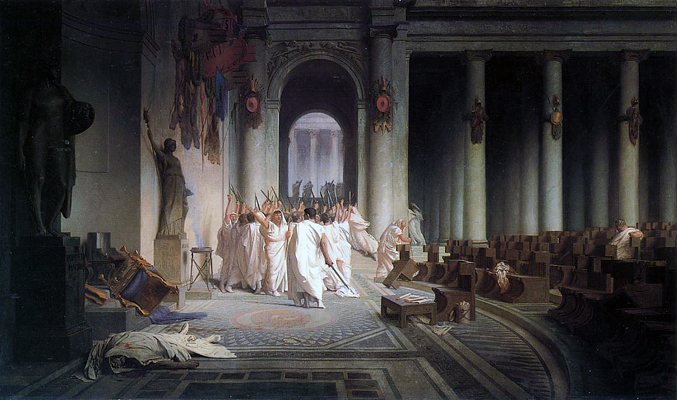
Suetonius relates that a soothsayer had warned Caesar that he was in grave danger, which would not laissez passer until the Ides had ended. Entering the building, Caesar now chided him that the twenty-four hours had arrived. "Yes," he replied, "just they take not notwithstanding gone." Every bit Caesar took his seat, the conspirators gathered around him on the pretext of presenting a petition. One then took hold of his majestic toga and ripped it away from his neck. A dagger was thrust at Caesar's throat simply missed and only wounded him. Another assassinator then collection a dagger into his breast as he twisted away from the first assailant. Brutus struck Caesar in the groin (a telling accident, perhaps, given that his mother Servilia once had been Caesar's mistress). Hemmed in, "Caesar kept turning," writes Appian, "from one to another of them with furious cries like a wild fauna." When he saw that Brutus, also, had drawn his dagger, Plutarch relates that Caesar simply covered his caput with his toga and sank to the footing. Although Suetonius records that Caesar died "uttering not a word," some, he says, had written that Brutus was reproached in Greek with the words Kai su, teknon, "You, besides, my kid?" It was these words that Shakespeare would later present in Latin every bit Et tu, Brute.
Fifty-fifty though the second wound after was idea to have been fatal, the conspirators continued to strike at Caesar, at times cutting one another with their own daggers, until they, besides, were covered in blood. Slumped confronting the pedestal of Pompey's statue, Caesar died, having been stabbed twenty-three times. "The pedestal was drenched with claret," writes Plutarch, "and so that ane might have idea that Pompey himself was presiding over this act of vengeance against his enemy, who lay in that location at his feet struggling convulsively under so many wounds."
If the conspirators had killed in the name of Republican libertas, in exercise they acted for the liberty of the Optimates themselves. There was to be no popular support for the act. To Appian, at least, "The Republic has been rotten for a long time. The urban center masses are now thoroughly mixed with foreign claret, the freed slave has the same rights every bit a citizen, and those who are still slaves look no unlike from their masters." It was every bit if the expiry of the tyrant alone was sufficient for the conspirators, with no thought being given to what would happen as a consequence. It all had been planned, relates Cicero, with the "courage of men and the foresight of children." Only the res publica would not be restored. The just outcome was what Caesar himself had predicted: "It is more important for Rome," Suetonius quotes him as saying, "than for myself that I should survive...should anything happen to me, Rome volition savor no peace." And so it was: ceremonious war would rage for some other thirteen years.
Gaius Julius Caesar was dead, having lived for fifty-five years. His torso was burned in a dandy pyre in the Forum Romanum, the site commemorated past the chantry in front of the Temple of Divine Julius. Residing still at Caesar'due south garden villa (Horti Caesaris) across the Tiber, Cleopatra would return to Egypt, together with Caesar'southward purported son Caesarion. Augustus subsequently would remove the statue of Pompey and have the Curia walled up, never to be used over again by the Senate. The assassins were condemned to decease under the constabulary of Pedius (Caesar'southward nephew), and would be hunted down and killed, "visiting with retribution all, without exception," says Plutarch. Iii hundred senators and two thousand equites eventually would die as well, including Cicero, his caput and correct mitt, the one with which he written his invective Philippics confronting Antony, displayed on the Rostra.
According to Dio, it was Antony, the virtually implacable fellow member of the Second Triumvirate (Octavius, Antony, and Lepidus), who carried out the retributions. He "killed savagely and mercilessly, non only those whose names had been proscribed, but also those who had attempted to assist any of them." Dio relates the poignancy of the proscriptions: "Many perished at the hands of their dearest friends, and many were saved by their bitterest enemies. Some slew themselves, and others were released by the very men who came upon them to murder them. Some who betrayed masters or friends were punished, and others were honoured for this very reason." And, since the members of the Triumvirate had their own friends and enemies, at that place were complications, "each having frequently occasion to want earnestly that the life of a man be spared whom one of the others wished to destroy, or, on the other mitt, that a man be put to death whom one of the others wished to have survive."
Both Brutus and Cassius eventually would accept their own lives, Cassius with the very dagger that he had used in the assassination. Although Caesar had spared them, they did not spare Caesar.
A millennium and a half later, Shakespeare has Antony speak in one of the finest examples of rhetorical irony:
The noble Brutus
Hath told you Caesar was ambitious.
If it were then, it was a grievous mistake,
And grievously hath Caesar answered it....
Come I to speak in Caesar's funeral.
He was my friend, faithful and simply to me.
But Brutus says he was aggressive,
And Brutus is an honorable man.
He hath brought many captives home to Rome,
Whose ransoms did the general coffers fill.
Did this in Caesar seem aggressive?
When that the poor have cried, Caesar has wept.
Ambition should be made of sterner stuff.
Still Brutus says he was aggressive,
And Brutus is an honorable man.
You all did see that on the Lupercal
I thrice presented him a kingly crown,
Which he did thrice reject.
Was this ambition?
Withal Brutus says he was ambitious,
And certain he is an honorable man.
I speak not to disprove what Brutus spoke,
But hither I am to speak what I do know.
You all did love him one time, not without crusade.
What cause withholds you then to mourn for him?Julius Caesar (Iii.2)
The Death of Caesar (1867) by Jean-Leon Gerome is in the Walters Art Gallery (Baltimore). It illustrates the Ides of March simply because the earlier painting (1798) of the same name by Vincenzo Camuccini is used so frequently.
References: Caesar: A Biography (1982) by Christian Meier; Caesar: Politician and Statesman (1968) by Matthias Gelzer; Plutarch: Fall of the Roman Republic (1972) translated past Rex Warner (Penguin Classics); Appian: The Civil Wars (1996) translated by John Carter (Penguin Classics); Plutarch: Makers of Rome (1965) translated by Ian Scott-Kilvert (Penguin Classics); Suetonius: The Twelve Caesars (1957) translated past Robert Graves (Penguin Classics); Dio'due south Roman History (1916) translated by Earnest Cary (Loeb Classical Library).
Meet also the Portico of Pompeii, the scene of Caesar's bump-off, and the Temple of Divine Julius, the location of his funeral pyre.
Source: https://penelope.uchicago.edu/~grout/encyclopaedia_romana/calendar/ides.html
0 Response to "according to casca what do the senators plan to do on the ides of march"
Post a Comment