Sony Cyber-shot Dsc-h300 201 Mp Compact Digital Camera Review
Introduction
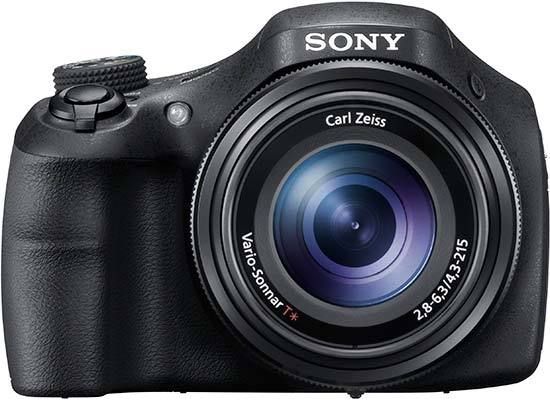
The Sony Cyber-shot DSC-HX300 is a new super-zoom photographic camera that features a 50x, 24-1200mm zoom lens, 20.iv megapixel back-illuminated Exmor R CMOS sensor, 1920x1080 50p Total HD video recording with stereo sound and HDMI output, and Sweep Panoramas and 3D Still Images. Other key features of the Sony HX300 include high-speed autofocusing, a tilting three-inch LCD screen with 921,000-dots, 10fps burst shooting fashion at full resolution, ISO range of 100-12,800, enhanced Optical SteadyShot with three-way Active Manner, Intelligent Car Plus, Superior Machine, Program and full Manual shooting modes, a range of Picture Effects and and support for both Retention Stick PRO Duo and Secure Digital cards. The Sony Cyber-shot DSC-HX300 is available in black for £419.00 / $449.99.
Ease of Use
Sony'due south new Cyber-shot DSC-HX300 is well-nigh identical to the HX200 model that information technology replaces, so a lot of the comments that we made in our review of that camera utilize as to the new HX300. The HX300 clearly takes its design cues from an entry-level DSLR photographic camera. It's one to be worn about the neck, slung over a shoulder - with the strap provided for both purposes - or tucked in a suitable camera bag. The HX300's optical zoom is now a massive 50x, upwards from the 30x zoom of its forebear, and the constructive resolution has been additional from xviii.2 meg to 20.iv million pixels from a 1/ii.3-inch Sony Exmor R CMOS sensor.
The HX300 has a very chunky handgrip that's large enough to squeeze 3 fingers comfortably around, helping to provide a steadier hold when shooting towards the extreme telephoto finish of the zoom. To further assistance forbid blurred shots in such circumstances and in low light, Sony has also provided optical 'SteadyShot' prototype stabilization, now further improved thanks to a second group of lens elements that shift rapidly to correct for tiny mitt tremors, reducing the milk shake apparent on the LCD screen and making it easier to frame the shot.
The build and finish of the Sony Cyber-shot DSC-HX300 is of high quality, with the all-black matt cease to the torso and various DSLR-like dials and controls - non to mention both angle-adjustable LCD and built-in electronic viewfinder - on initial inspection lending information technology an impression of being a 'serious' enthusiasts' model. The compact size besides means that locating the correct control is never a stretch for forefinger or thumb. Almost of the features you desire to access are literally at your fingertip, which of course makes for speedier overall operation. Overall dimensions are 129.6x93.2x1.03.2mm and the HX300 weighs a starter DSLR-like 623g, making it both bigger and heavier than it predecessor and virtually of the super-zoom competition.
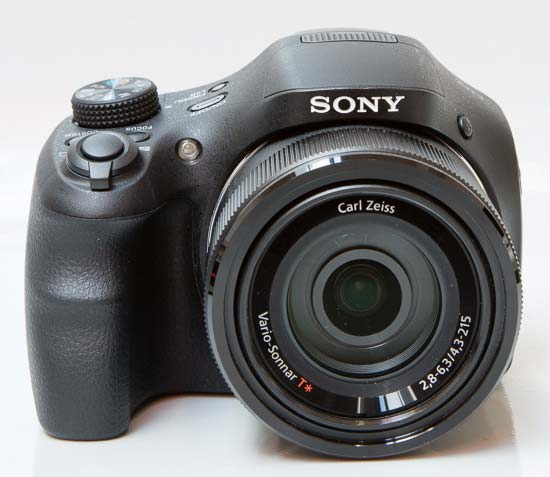
The front end of the Sony Cyber-shot DSC-HX300 is dominated by the Carl Zeiss Vario-Sonnar lens, hither boasting a maximum aperture of f/2.8 at the widest-angle setting and a focal range the equivalent of a ultra-broad-bending 24mm to 1200mm in 35mm moving-picture show terms - suggesting serious 'poke' at the telephoto end and real suitability for those paparazzi style candid portraits at full zoom, as well every bit of course landscapes and group portraits at the wider end.
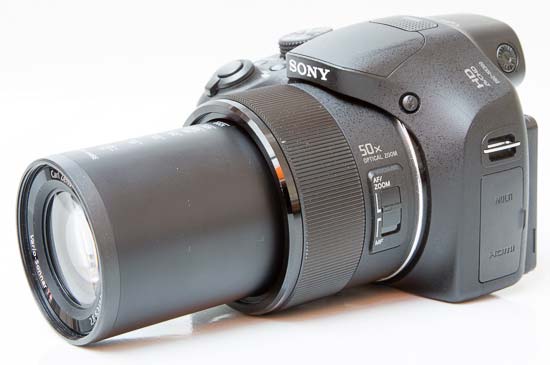
Nosotros also get an AF assist/cocky time lamp porthole top left of the lens when viewing the camera front on. The butt itself features a lens ring, which will concur real entreatment for photographers who prefer to get hands on, as this non only controls the zoom - if you don't want to apply the compact camera-style lever that alternatively encircles the shutter release button - but can also be used to focus if flicking the switch at the side of the lens to 'MF' mode.
The top plate of the camera extends the HX300's sophisticated expect and experience, with a stereo microphone sitting just backside the otherwise hidden raised flash. To the right of this, when looking down at the photographic camera equally y'all grip it in both hands, is a minor button for swapping between use of the EVF and LCD. Note that at that place'due south no longer an centre sensor on the HX300, unlike its predecessor, something that we sorely missed in practice.
The next command along is the narrow lozenge shaped on/off button, with an embedded lamp that glows light-green when the camera is switched on, or orange if the battery is low and the unit is existence recharged. Incidentally nosotros don't get a separate mains charger here. We get a mains lead, adapter and plug instead, meaning that the lithium ion pack is charged in-camera. When your battery is down, so is the camera therefore.
The Cyber-shot HX300 takes roughly two seconds to ability upwardly, lens extending a little across its protective housing to get in at maximum wideangle setting while the image on the rear LCD pops into life. While slower than an bodily DSLR, that's respectable enough for this class of span camera.
The photographic camera is commendably swift to determine focus and exposure, with the green AF point/due south highlighted on-screen the very instant your finger presses down on the shutter release push and finds the half way point. Press down fully to take the shot and a total resolution 20 megapixel JPEG is committed to removable media carte du jour in just over two seconds - so respectably swift. Face up detection/selection and tracking focus are also offered hither equally standard features, activated or de-activated via a printing of the unmarked button at the centre of the Sony'southward backplate command pad.
Keep a forefinger on the zoom lever that encircles the shutter release button and the HX300 powers through its 50x optical zoom range from wide angle to telephoto in around iv seconds. The alternative method is to employ the transmission zoom band as already mentioned, though this is slower to respond than using the zoom lever. However the consequence is that it's slightly easier to make it at more precise framing.
Next to the ability button is a raised, ridged-edged shooting mode button with an activity that is stiff plenty to preclude the user accidentally slipping from i setting to the adjacent in the thick of it. There are 11 options on this dial. We get the creative quartet of program, shutter priority, aperture priority and manual mode settings plus Sony's now ubiquitous Sweep Panorama part, whereby the user pans through an arc as directed by the on-screen arrows - the resulting elongated shot automatically stitched together in camera. It'due south both very effective and very easy to use.
Next to this setting we get a retention retrieve mode, which, every bit the camera describes recalls registered settings and resumes shooting. This feels slightly superfluous every bit nosotros plant the photographic camera didn't lose the previous settings when it was turned off and then switched back on again.
Also on the punch is a dedicated Loftier Definition video manner for upwards to 1920x1080 pixels clips at 50 frames per second progressive capture, which complements the defended video record push top correct of the backplate. While a press of the latter begins a recording despite the fact that you might take a stills shooting mode selected on the punch at the time, a press of the Carte du jour button when in video manner and accesses a variety of options. Hither we can not just adjust video resolution and vary the frame rate, only also switch from intelligent auto video recording to applying a specific scene mode, every bit nosotros more commonly can with stills photography. There'south the ability to filter out external wind racket too, while another bonus is that total use of the optical zoom is provided in movie mode, as is automatic focus aligning if you modify framing or bandy subjects mid sequence.
This being a Sony camera we likewise expectedly discover a 3D mode on the photographic camera - with the ability to capture 3D stills or Sweep Panoramas as MPO files merely viewable in the stereoscopic glory on a suitably equipped Goggle box, or alternatively in that location is Sony's Sweep Multi Angle mode which provides a lenticular print blazon view on the photographic camera's LCD screen, so at least you tin get a 3D type effect in situ.
Scene modes are up next and there are 16 user selectable options on the HX300, covering everything from the usual portraits - including a dissever DSLR-fashion 'groundwork defocus' option - to shooting landscapes past nighttime and even handheld; pet, embankment, snow and fireworks mode round out the more than usual suspects.
Rounding off the shooting mode options are both the scene and subject recognizing and thereby automatically adjusting Intelligent Auto fashion, plus Superior Auto mode. The latter is, if you volition, your in-camera version of Photoshop, adjusting images on the fly. This means that there is a little additional automatic processing happening in this manner, so it's slower to go an image from capture to menu than when shooting in, say, Program way. But it is a welcome aid in trickier atmospheric condition such as low calorie-free and does allow the user to point and shoot rather than having to notice and change the ISO setting manually.
Incidentally the sensitivity range is broad and stretches from ISO to ISO12,800 with many incremental points in between. Our only moan is that we could have really done with a dedicated ISO button marked every bit such. At that place is a 'custom' push button provided alongside the ane for 'focus' just backside the shutter release on the top plate, just there'due south a choice of dedicating this to auto exposure lock (AEL), white balance, metering mode or switching on the grinning shutter facility. With the shutter release push and the zoom lever that encircles it comfortably sloping frontward at the summit of the handgrip, that'due south it for the HX300'south top plate.
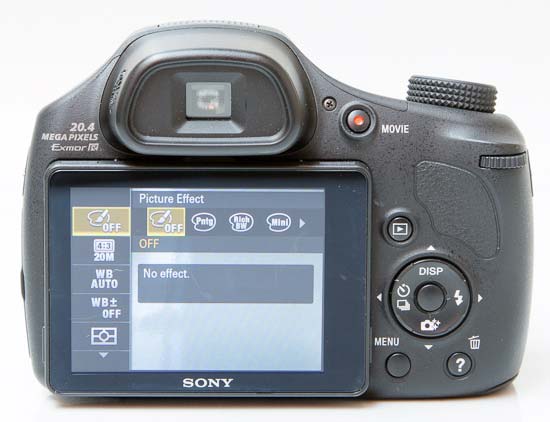
The rear of the HX300 is dominated by the tilting three-inch, 921k dot resolution LCD screen, which can be angled upwardly or down, but non swung out through 180° so it sits aslope the body, like with a camcorder, or flips inward to face the body itself. This means that, whilst very useful in itself compared with a fixed monitor, information technology is best used for achieving those otherwise awkward low or high angle shots than anything more aggressive. The alternative as mentioned earlier is to use the EVF ranged directly above the LCD, though as this is both smaller and has a lower resolution (202k dots), we found it easy to overlook.
In terms of controls the back of the photographic camera looks slightly sparse mainly due to the minor dimensions of the bodily buttons, though in fact most of the essentials are here. A dedicated picture push is located to the right of the viewfinder, while a DSLR-similar jog dial sits aslope that, where it automatically falls under the thumb of the right paw as the camera is gripped. If you lot're shooting in Program mode a press of this allows access to the likes of ISO, shooting speed and discontinuity value on screen, though we had to press quite hard and repeatedly to arrive on the settings required - each highlighted in turn - at which signal a spin of the same dial is required to make alterations. It works, simply requires a period of familiarization, and is more fiddly than simply selecting ISO speeds from an on-screen bill of fare or toolbar.
Speaking of toolbars, beneath the movie tape and playback buttons on the rear of the camera is one marked Menu, a press of which summons a toolbar. This appears ranged to the left hand side of the screen. Information technology's here that we have access to the camera's set upward folders and the in-photographic camera help guide, even though a dedicated button marked with a question mark is additionally provided for such a purpose. Also on the toolbar is a means of saving chosen settings to the Memory Recall style provided on the top plate shooting dial, choosing betwixt two Steadyshot options when recording video ('standard' or the stronger 'Agile'), fixing movie quality, deploying noise reduction, individually controlling sharpness, contrast and color saturation (with 'standard' beingness the default setting), plus switching betwixt the default 'standard' colour mode and vivid, 'real', sepia or black and white toned options.
In addition, the intensity of the flash can exist dialed up or dialed down, the sensitivity of the 'smile shutter' characteristic can likewise be altered to annals a slight up-plough of the oral fissure or alternatively a big goofy grinning, or the automatic feature turned off entirely. Furthermore we get three exposure and one white balance bracketing options, continuous burst shooting of either 10fps per second for up to 10 sequential shots or 2fps to the same number, plus pick of metering modes (multi segment, middle weighted or spot). Nevertheless image size can of course besides be adjusted via this same left-of-screen toolbar, with xx megapixels in iv:three aspect ratio existence the top setting.
Lastly at the end of this exhaustive list we find a smattering of fun picture consequence options. Hither these comprise a painterly High Dynamic Range option, a chrome like rich-tone monochrome, the ubiquitous toy photographic camera and miniature furnishings, pop art, soft high cardinal, watercolour, and a funky illustration outcome emphasizing field of study outlines but smoothing the item therein.
The familiar four-way command pad at the bottom right of the HX300's backplate features options for controlling the rear display, wink settings (with red eye reduction turned on or off via the menu screens), self timer (two or 10 seconds) plus, more unusually, bringing up some on-screen 'photo inventiveness' options if the user is shooting in ane of the auto modes. Selecting this option on the pad, for example, allows users to darken or lighten the prototype past flicking the jog dial left or right. Colour can also be adjusted in the aforementioned way and the picture effect options previously detailed can be flicked through via a virtual mode dial. It reminds us a lot of the Live Guide feature on Olympus Pen cameras; namely it allows newcomers to exert some personal control over the event of their shots without knowing anything well-nigh exposure values, aperture settings and so on, with adjustments shown on screen live and in real time earlier the shutter release button has even been pressed.
On either flank of the camera is a metallic lug for attaching the provided shoulder strap, while on the left hand flank at that place is a flip-open door protecting the photographic camera's two ports. Here we get an HDMI output and the new Multi Concluding Interface port which allows the connection of a growing range of accessories. Incidentally battery life of the lithium ion prison cell inserted in the base of the handgrip is effectually 300 shots, quite a large reduction on its predecessor's 450+ shot life. On the bottom of the HX300 is a metallic screw thread located and a compartment housing the battery and a slot for either Memory Stick PRO Duo or Secure Digital cards.
Image Quality
All of the sample images in this review were taken using the 20.4 megapixel JPEG setting, which gives an boilerplate paradigm size of around 6Mb.
The Sony CyberShot DSC-HX300 produced images of good quality during the review period. It handled noise fairly well, with a little noise appearing at the relatively slow speed of ISO 400 and then becoming progressively worse at the faster settings of ISO 800 and 1600. The fastest settings of ISO3200-12,8000 all suffer from a loss of fine particular, and so much and so that nosotros wouldn't apply any of them unless absolutely neccesary.
Chromatic aberrations were in prove merely were well-controlled, with some limited purple fringing effects appearing in high contrast situations. The xx megapixel images were a trivial soft straight out of the photographic camera at the default sharpen setting and require some further sharpening in an application like Adobe Photoshop, or you can increase the in-camera sharpening level.
Macro functioning is excellent, allowing you to focus every bit close equally 1cm away from the subject. Commendably barrel distortion is well controlled even at the 24mm wide-angle focal length of the incredibly versatile 50x zoom lens. The built-in wink worked well indoors, with no crimson-middle and adequate overall exposure. The maximum shutter speed of 30 seconds allows the cameras to capture enough calorie-free for most afterwards-dark situations.
The Backlight Correction HDR feature dramatically increases the item in the shadow and highlight areas, although we miss existence able to cull but how much correction is practical. There's a good range of Color Modes and Picture Effects on offer, while the Sweep Panorama mode makes it simple to take wide-vista shots.
Noise
At that place are 8 ISO settings available on the Sony Cyber-shot DSC-HX300. Here are some 100% crops which evidence the noise levels for each ISO setting.
| ISO lxxx (100% Crop) | ISO 100 (100% Crop) |
 |  |
| ISO 200 (100% Ingather) | ISO 400 (100% Crop) |
 |  |
| ISO 800 (100% Crop) | ISO 1600 (100% Crop) |
 |  |
| ISO 3200 (100% Crop) | ISO 6400 (100% Crop) |
 |  |
| ISO 12800 (100% Ingather) | |
 |
Focal Range
The Sony Cyber-shot DSC-HX300's 50x zoom lens offers an incredibly versatile focal range, as illustrated by these examples:
| 24mm | 1200mm |
 |  |
Sharpening
Here are two 100% crops which have been Saved as Web - Quality 50 in Photoshop. The right-paw image has had some sharpening practical in Photoshop. The out-of-the camera images are just a little soft and ideally benefit from some further sharpening in a program similar Adobe Photoshop. Alternatively you can change the in-camera sharpening level.
| Original (100% Crop) | Sharpened (100% Crop) |
 |  |
 |  |
Chromatic Aberrations
The Sony Cyber-shot DSC-HX300 handled chromatic aberrations well during the review, with some purple fringing nowadays effectually the edges of objects in loftier-dissimilarity situations, every bit shown in the examples beneath.
| Chromatic Aberrations 1 (100% Ingather) | Chromatic Aberrations 2 (100% Crop) |
 |  |
Macro
The Sony Cyber-shot DSC-HX300 allows you to focus on a subject field that is just 1cm away from the camera when the lens is set to wide-angle. The first epitome shows how close you can get to the subject (in this case a compact flash carte). The 2nd image is a 100% crop.
| Macro | Macro (100% Crop) |
 |  |
Flash
The flash settings on the Sony Cyber-shot DSC-HX300 are Machine, Forced Flash, Dull Syncro, No Flash, with a Red-eye Reduction option in the Principal menu. These shots of a white coloured wall were taken at a distance of 1.5m.
| Suppressed Flash - Wide Angle (24mm) | Forced Wink - Wide Angle (24mm) |
 |  |
| Suppressed Flash - Telephoto (1200mm) | Forced Wink - Telephoto (1200mm) |
 |  |
And here are some portrait shots. Equally yous tin see, both the Forced Wink setting or the Red-Eye Correction option caused a tiny amount of red-eye.
| Forced Flash | Forced Flash (100% Ingather) |
 |  |
| Red-center Reduction | Red-heart Reduction (100% Crop) |
 |  |
Night
The Sony Cyber-shot DSC-HX300'southward maximum shutter speed is 30 seconds in the Transmission mode, which is swell news if y'all're seriously interested in nighttime photography. The shot below was taken using a shutter speed of 15 seconds at ISO 80.
| Night | Nighttime (100% Crop) |
 |  |
Groundwork Defocus
Groundwork Defocus attempts to mimic the sharp subject and out-of-focus background effect that DSLR owners typically savour, shooting ii frames in quick succession and varying the aperture betwixt each one.
| On | On (100% Crop) |
 |  |
Backlight Correction HDR
DRO is Sony's solution for improving shadow and highlight detail in photos taken in contrasty calorie-free, significantly increasing the image's dynamic range. The examples evidence the rather dramatic effect of turning this feature on.
| Off | On |
 |  |
Picture Effects
The Sony Cyber-shot DSC-HX300 offers a range of nine creative Picture Furnishings.
| Off | HDR Painting |
 |  |
| Rich-tone Monochrome | Miniature |
 |  |
| Toy Camera | Pop Colour |
 |  |
| Partial Color (Ruby) | Soft High-key |
 |  |
| Watercolor | Illustration |
 |  |
Moving picture Effects
The Sony Cyber-shot DSC-HX300 offers a range of iv color modes.
| Off | Vivid |
 |  |
| Existent | Sepia |
 |  |
| B&W | |
 |
Intelligent Sweep Panorama
The Sony Cyber-shot DSC-HX300 allows you to take panoramic images very hands, past 'sweeping' with the photographic camera while keeping the shutter release depressed. The camera does all the processing and stitching and even successfully compensates for moving subjects, with the new Loftier Resolution fashion successfully creating a 40+ megapixel image.
| Standard |
 |
| Wide |
 |
| 360 |
 |
| High Resolution |
 |
Sample Images
This is a selection of sample images from the Sony Cyber-shot DSC-HX300 camera, which were all taken using the xx.four megapixel Fine JPEG setting. The thumbnails below link to the total-sized versions, which have not been altered in any way.
Sample Movie & Video
This is a sample video from the Sony Cyber-shot DSC-HX300 camera at the highest quality setting of 1920x1080 pixels at fifty frames per 2nd. Please annotation that this 22 second picture is 68.7Mb in size.
Product Images
 |
| Forepart of the Sony Cyber-shot DSC-HX300 |
 |
| Front of the Sony Cyber-shot DSC-HX300 / Turned On |
 |
| Front end of the Sony Cyber-shot DSC-HX300 / Pop-up Flash |
 |
| Side of the Sony Cyber-shot DSC-HX300 |
 |
| Side of the Sony Cyber-shot DSC-HX300 |
 |
| Rear of the Sony Cyber-shot DSC-HX300 / Tilting LCD Screen |
 |
| Side of the Sony Cyber-shot DSC-HX300 |
 |
| Rear of the Sony Cyber-shot DSC-HX300 |
 |
| Rear of the Sony Cyber-shot DSC-HX300 / Image Displayed |
 |
| Rear of the Sony Cyber-shot DSC-HX300 / Turned On |
 |
| Rear of the Sony Cyber-shot DSC-HX300 / Main Carte |
 |
| Rear of the Sony Cyber-shot DSC-HX300 / Settings Menu |
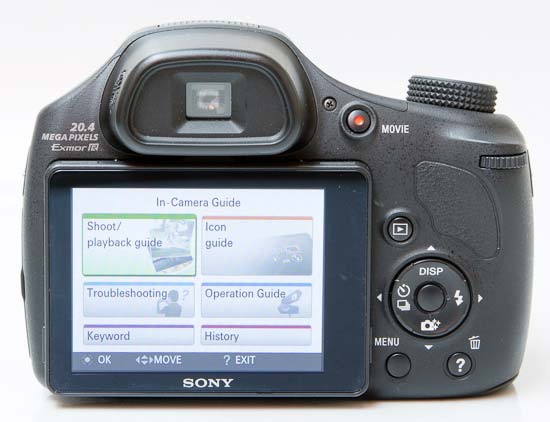 |
| Rear of the Sony Cyber-shot DSC-HX300 / In-Sony Cyber-shot DSC-HX300 Guide |
 |
| Rear of the Sony Cyber-shot DSC-HX300 / Tilting LCD Screen |
 |
| Rear of the Sony Cyber-shot DSC-HX300 / Tilting LCD Screen |
 |
| Rear of the Sony Cyber-shot DSC-HX300 / Tilting LCD Screen |
 |
| Top of the Sony Cyber-shot DSC-HX300 |
 |
| Bottom of the Sony Cyber-shot DSC-HX300 |
 |
| Side of the Sony Cyber-shot DSC-HX300 |
 |
| Side of the Sony Cyber-shot DSC-HX300 |
 |
| Front of the Sony Cyber-shot DSC-HX300 |
 |
| Front of the Sony Cyber-shot DSC-HX300 |
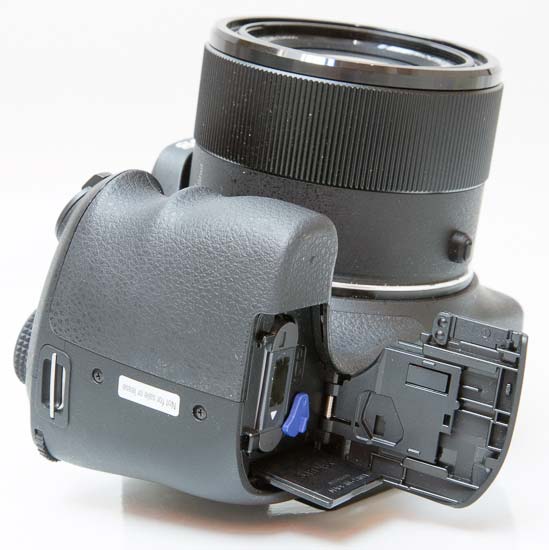 |
| Retention Card Slot |
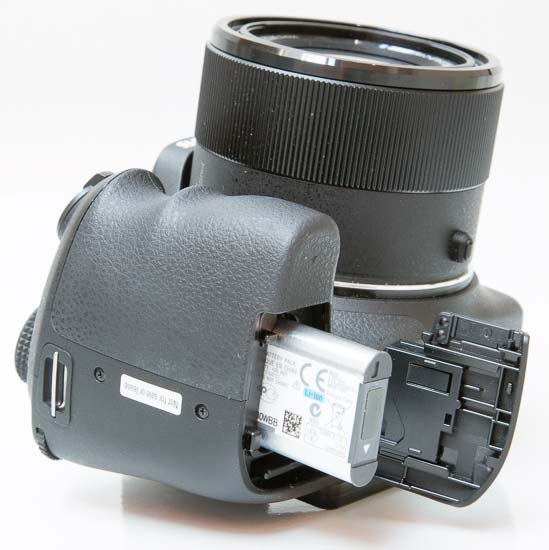 |
| Battery Compartment |
Conclusion
The Sony Cyber-shot DSC-HX300 is a rather small-scale update of last year's HX200V model, principally adding a bigger 50x zoom and slightly more than megapixels. This doesn't feel like plenty of a pace forrad though, specially as almost of our criticisms of the HX300 haven't been addressed, namely a lack of directly admission to the ISO speed and other primal settings, a missing second control wheel, no RAW format support, a low-resolution electronic viewfinder, an LCD that can only be tilted upward and downwardly, and the disability to attach an external flashgun. The motion to a twenty megapixel sensor, while looking good on paper, has resulted in slightly poorer epitome quality than the HX200 offered, and that photographic camera'south GPS functionality has disappeared entirely from the 2013 model.
The inclusion of a 50x zoom lens means that the Sony Cyber-shot DSC-HX300 offers the same 24-1200mm focal length equally one of its principal rivals, the Catechism PowerShot SX50 HS. Commendably we were able to achieve sharp results shooting handheld even at the far reaches of the zoom, although the camera somewhat inevitably increased the ISO speed to try and recoup, resulting in noisier images. Still, its heartening to discover that the 50x zoom is actually a lot more usable in existent-life than you might first imagine. Nosotros are disappointed that the electronic viewfinder withal only has a resolution of 202k dots, specially considering that it's imperative to compose your photos through the viewfinder given the huge focal range, and there'due south no longer any automated switching between LCD and EVF either when you hold the camera up to your centre.
The Sony Cyber-shot DSC-HX300 ultimately suffers in comparison to the Canon PowerShot SX50 HS, Fujifilm FinePix HS50 EXR and Panasonic Lumix DMC-FZ200 by non offer plenty prosumer features, especially when you factor in its high price-tag. In a crowded market with less well-specified models available at cheaper prices and improve-specified alternatives for the same kind of money, it's difficult to more whole-heartedly recommend the Sony Cyber-shot DSC-HX300, fifty-fifty thought that 50x zoom lens is literally difficult to ignore.

| Ratings (out of 5) | |
|---|---|
| Blueprint | 4 |
| Features | iv |
| Ease-of-use | 4.5 |
| Image quality | iv |
| Value for money | 4 |
Review Roundup
Reviews of the Sony Cyber-shot DSC-HX300 from around the web.
The Sony Cybershot DSC-HX300 has a 20.4 megapixel Exmor R CMOS sensor and 50x optical zoom lens, which is a 35mm equivalent of 24-1200mm. To keep your images as sharp every bit possible in that location is Optical SteadyShot, ideal when shooting with a lot of zoom. The zoom can exist extended to 100x with Clear Image Zoom and the HX300 can also shoot full resolution images at up to 10 fps.
Read the full review »
Superzoom cameras across various brands have been crafting out their own private points of interest of late. Sony's angle, it would seem, is all well-nigh resolution: the Cyber-shot HX300 pairs a make new 50x optical zoom lens - capable of a 24-1200mm equivalent - with a new 20.iv-megapixel CMOS sensor.
Read the total review »
In light of the danger to the compact camera market posed by the rising of smartphones, Sony is concentrating on 2 key areas where defended meaty cameras still have the reward: image quality and zoom range. In fact, 80% of Sony'southward compact cameras in 2013 will exist 'high-zoom' types. New models, the HX300 and WX300, both feature new sensors and improved optical zooms over their predecessors. The HX300, on test here, offers the widest zoom in Sony's range.
Read the full review »
Specifications
Lens
| Optical Zoom | 50x (Optical Zoom during movie recording) |
| Clear Image Zoom | 100x |
| Digital Zoom | Nonetheless Prototype: 20M Approx. 200x / 10M Approx. 284x / 5M Approx. 400x / VGA Approx. 810x / 15M (16:9) Approx. 200x / 2M (16:nine) Approx. 540x. Movie: Precision Digital Zoom Approx. 200x |
| F | F2.8 (West) - 6.3 (T) |
| Focal Length (f= mm) | 4.iii-215 |
| Focal Length (f=35mm conversion) | 24-1200 (4:3), 26-1300 (16:9) |
| Macro (cm) | iAuto: AF (W: Approx. 1cm (0.03 ft.) to Infinity, T: Approx. 240cm (7.87 ft.) to Infinity) / Program Auto: AF (Westward: Approx. 1cm (0.03 ft.) to Infinity, T: Approx.240cm (7.87 ft.) to Infinity) |
| Filter Diameter (mm) | NO |
| Conversion Lens compatibility | NO |
| Carl Zeiss® lens | Yes |
| Sony G | NO |
Image Sensory
| Sensor Type | Exmor R™ CMOS Sensor |
| Size (Inches) | 1/ii.3 type(7.76mm) |
SteadyShot
| SteadyShot capability | Yes |
| Optical SteadyShot adequacy | YES |
Auto Focus Organization
| AF Illuminator | Auto / Off |
Built-in-Wink
| Flash Manner | Automobile / Flash On / Slow Synchro / Rear Slow Synchro / Flash Off / Advanced Flash |
| Red-Centre Correction | Auto / On / Off |
| Auto Daylight Synchronized Flash | NO |
| Altitude limitations using Wink (1000) | ISO Auto: Approx.0.3m to 12.4m(xi seven/8 inches to 40 feet eight i/4 inches)(Westward) / Approx.2.0m to 5.9 1000(6feet 6 three/4 inches to xix feet 4 3/viii inches)(T), ISO3200: up to Approx.17.5 m(57 feet 5 1/8 inches)(W) |
LCD/ Viewfinder
| LCD Screen Size (inches) | 7.5cm (iii.0type) |
| LCD Total Dots Number | 921.600 |
| LCD Monitor Type | TFT LCD |
| Auto Brilliant Monitoring | Yes |
| Optical Viewfinder | Yes |
| Electrical Viewfinder | NO |
Recording
| Recording Media | Memory Stick™ Duo / Memory Stick PRO Duo™ / Retentivity Stick PRO Duo™ (high speed) / Memory Stick PRO HG Duo™ / Retentiveness Stick Micro* / Retention Stick Micro / Retentiveness Stick XC-HG Duo |
| Recording Media Two | SD Memory Card / SDHC Retention Bill of fare / SDXC Memory Card / microSD Memory Menu* / microSDHC Memory Card* |
| Recording Format | JPEG |
| DCF (Design rule for Photographic camera File Arrangement) | Yes |
| DPOF (Digital Print Order Format) | YES |
| Flare-up Mode (shots) | Approx.10 fps |
| Burst Interval (approximately sec) | Approx.0.one sec.(10 shots) |
| However Image size (20M five,184 x 3,888) | YES |
| Still Epitome size (18 M 4896×3672) | NO |
| Still Image size (14M 4320 10 3240) | NO |
| Still Image size (13M 4224 10 3168) | NO |
| Still Image size (12M 4000 x 3000) | NO |
| Withal Image size (10M 3648 x 2736) | YES |
| Still Paradigm size (9.0M, 3456 x 2592) | NO |
| Still Image size (8.0M, 3264 x 2448) | NO |
| Still Prototype size (7.2M 3072 x 2304) | NO |
| All the same Image size (5.0M, 2592 x 1944) | YES |
| Still Image size (3.1M, 2048 10 1536) | NO |
| Withal Epitome size (VGA, 640 x 480) | Yep |
| Still Epitome size (xvi:ix mode, 1920 x 1080) | Yes |
| Notwithstanding Paradigm size (16:nine mode, 4896X2752) | NO |
| Notwithstanding Image size (sixteen:9 mode, 4,608 x 2,592) | NO |
| Yet Image size (16:ix mode, 4,320 10 2,432) | NO |
| Notwithstanding Image size (16:9 style, 4000 ten 2248) | NO |
| Withal Paradigm size (iii:ii mode, 4000 x 2672) | NO |
| Still Image size (3:ii way 3648 x 2432) | NO |
| Still Paradigm size (iii:2 manner 3456 x 2304) | NO |
| 2D Panorama | 360° (11,520 x 1,080) / Hr (10,480 ten four,096) / Wide (vii,152 x 1,080/4,912 10 ane,920) / Standard (4,912 x i,080/iii,424 x ane,920) |
| 3D Panorama | NO |
| Moving Prototype Size (1920x1080 50p Approx.28Mbps) | Yeah |
| Moving Epitome Size (1920x1080 50i Approx.24Mbps) | YES |
| Moving Image Size (1920x1080 50i Approx.17Mbps) | YES |
| Moving Epitome Size (1440x1080 25fps Fine Approx.12Mbps) | YES |
| Moving Image Size (1440x1080 50i Approx.9Mbps) | Yeah |
| Moving Image Size (1280x720 30fps Standard Approx.6Mbps) | NO |
| Moving Paradigm Size (640x480 30fps Approx.3Mbps) | NO |
| Moving Image Size (640x480 25fps Approx.3Mbps) | Yep |
| Moving Image Size (320x240 30fps) | NO |
| Moving Epitome Size (AVCHD 1920 x 1080(50i, Interlace) Approx.24Mbps(Average bit-rate)) | NO |
Playback/ Edit
| Hd (High Definition) Playback | YES (HDMI® out) |
| Slideshow (Playback/Music/Moving picture) | Yep |
| Trimming | YES |
| Playback Zoom | YES (8x) |
| Cue & Review (MPEG) | Aye |
| Index Playback | 16 / 25 images |
| Epitome Rotation | Aye |
| Car Image Rotation | YES |
| Motorcar grouping and & All-time Motion picture Recognition | YES |
General
| Battery Remaining Indicator | NO |
| Histogram Indicator | Yep |
| PTP (Picture Transfer Protocol) | NO |
| Print Image Matching | YES |
| PictBridge | NO |
| Shop Front end Way | YES |
| Start upward time (approximately sec) | Approx. 2.0 sec. |
| Menu Language | English, French, German, Castilian, Italian, Portuguese, Dutch, Swedish, Norwegian, Danish, Finnish, Polish, Czech, Hungarian , Turkish, Greek, Bulgarian, Croatian, Romanian |
Jacks
| Multi use Terminal with Hd | Multi/Micro USB Concluding, Hi-Speed USB (USB2.0), Micro HDMI |
| Multi utilize Terminal | YES |
| AV Out | NO |
| USB two.0 Hi-Speed | YES |
Power/ Others
| Battery System | Lithium N |
| Supplied Battery | NP-BX1 |
| Stamina> (battery life) with the supplied battery(southward) in normal shooting condition | Approx. 310 / Approx. 155min (EVF:Approx. 400 / Approx. 200min) |
| Bombardment for Clock | NO |
| Weight (k) | Approx. 623g (1lb 6.0oz.) |
| Weight with Accessories (g) | Approx. 650g (1lb 6.9oz.) |
| Supplied Software | PlayMemories Home |
| Supplied Accessories | Rechargeable Battery Pack NP-BX1, Air-conditioning AdaptorAC-UB10/UB10B/UB10C/UB10D, Micro USB, Educational activity Manual, Shoulder strap, Lens cap |
Dimensions
| Width (mm) | 129.6 |
| Tiptop (mm) | 93.2 |
| Depth (mm) | 103.2 |
Disclaimers
| * | Requires adaptor (non supplied) |
Your Comments
- Introduction
- Ease of Utilise
- Image Quality
- Sample Images
- Product Images
- Conclusion
- Review Roundup
- Specifications
Source: https://www.photographyblog.com/reviews/sony_cybershot_dsc_hx300_review
0 Response to "Sony Cyber-shot Dsc-h300 201 Mp Compact Digital Camera Review"
Post a Comment